FREE RUNNING GAIT ANALYSIS AT THE DERBY RUNNER* AND WHAT GAIT ANALYSIS IS!
Your running footwear is the single most important part of your athletic kit. Think of it like the tyres on your car—if they're not the correct size or specification, performance suffers, and damage can occur. Would you buy tyres without knowing the right size? Or drive on ones that are 10 years old and worn down? The same principle applies to your running shoes.
When it comes to high-impact activities like running, power walking, or aerobics, wearing the correct footwear is critical. Repetitive foot strikes can place significant stress on muscles and joints, and wearing the wrong shoes can lead to common injuries such as shin splints, plantar fasciitis, and stress fractures. These issues often stem from poor biomechanics, particularly in the lower limbs.
That’s where Gait Analysis becomes invaluable. Gait analysis evaluates how your foot and lower leg move while in motion, highlighting how your body’s muscular, skeletal, and neural systems interact. It plays a key role in understanding joint movement, energy transfer, and force distribution—factors that directly impact running efficiency and injury prevention.
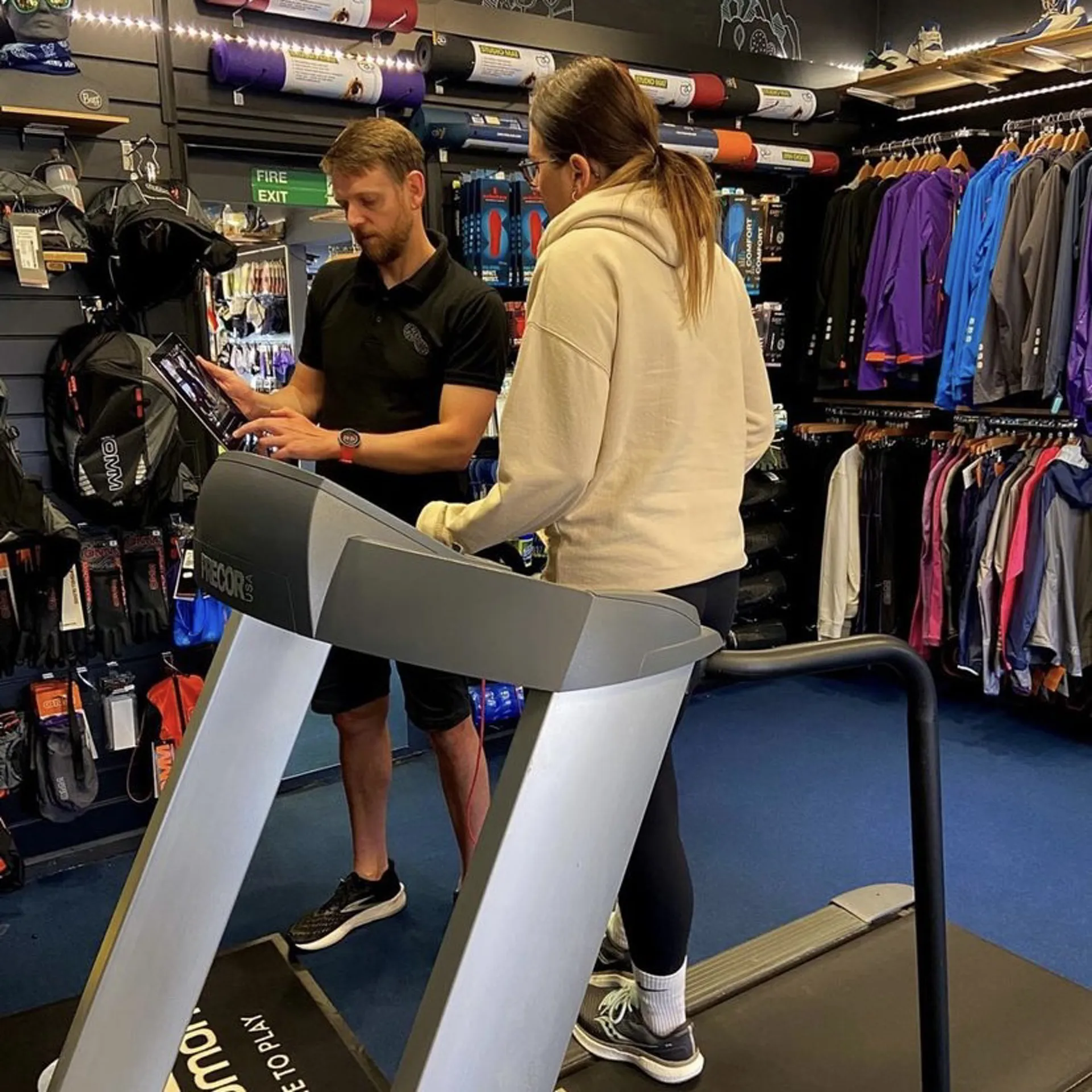 At The Derby Runner, we use slow-motion video gait analysis on a treadmill to assess each customer’s foot strike, pronation, and overall biomechanics. By reviewing the footage frame-by-frame, our trained staff can accurately determine your foot type and recommend the most suitable shoe based on support level, size, width, and activity. At The Derby Runner, we use slow-motion video gait analysis on a treadmill to assess each customer’s foot strike, pronation, and overall biomechanics. By reviewing the footage frame-by-frame, our trained staff can accurately determine your foot type and recommend the most suitable shoe based on support level, size, width, and activity. Understanding ankle pronation—the natural inward roll of the foot during movement—is also crucial. While pronation helps absorb shock and distribute weight, excessive or insufficient pronation can increase injury risk. Different foot types require varying levels of support to control pronation effectively, and that’s why personalized gait analysis is so important. With a wide range of shoes designed for different foot types, our team ensures every customer receives tailored advice. Whether you’re a beginner or a seasoned runner, gait analysis is the first step toward finding the right footwear—and protecting your long-term performance and health.

Why is there considered a safe range and unsafe range of pronation?
A safe range of pronation allows for efficent shock absorption, a stable foot push off and minimal stress on tendons and ligaments. For most individuals this is around 6-10 degrees of rearfoot eversion (see image to the left). These numbers dont apply to everyone.
Pronation may become problematic when there is excessive eversion and when the eversion is rapid. These factors can cause stress on the Plantar Fascia, Tibialis Posterior Tendon, Achilles Tendon, knee and Hip.
Modern research suggest that there is no universally unsafe angle of over pronation. Instead inury risk depends on a multitude of factors. Including but not limited to:
- Running Volume
- Speed
- Muscular strength
Speak to our instore experts for more information.
What To Expect!
- Gait analysis will last anywhere from 30 to 90 seconds this provides our staff with a full range of videos to issue feedback to yourself, and get the most out of our services.
- Staff will ask for you to run at aa pace that feels 'conversational' meaning easy enough to run at for 25 minutes.
|